
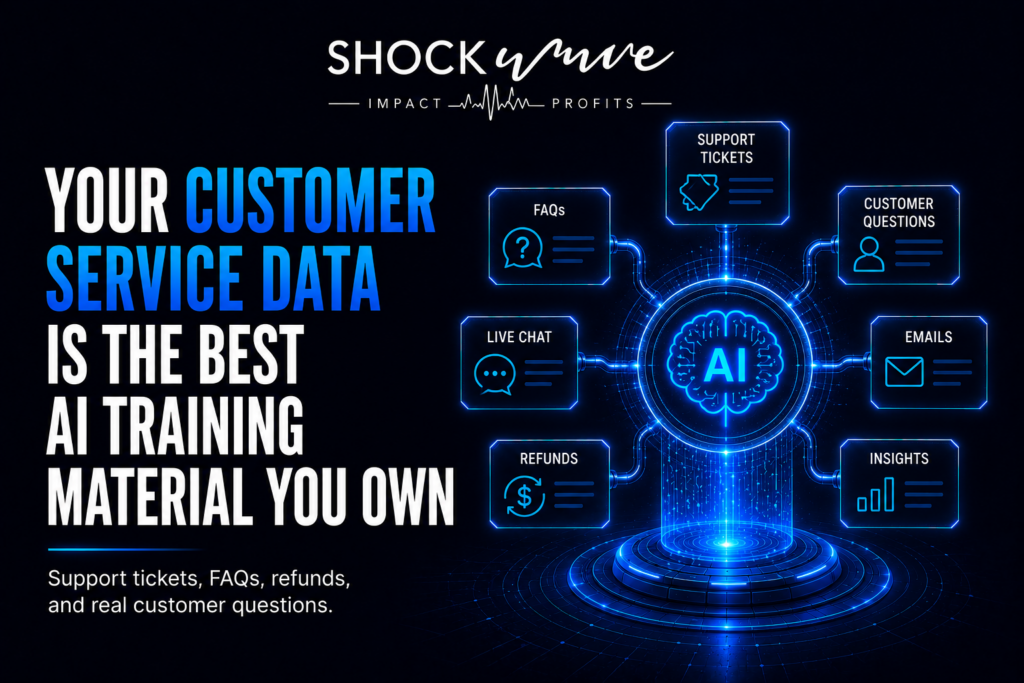
Customer service data AI training is one of the most practical ways to build useful AI agents because it starts with information your business already has.
Support tickets, emails, chat logs, call notes, refund requests, product questions, objections, complaints, macros, FAQs, and escalation history show what customers actually need help with. That data is often more valuable than a generic prompt because it reflects the real language, expectations, confusion, and friction points inside the business.
Most companies treat customer service data as something that belongs only to the support team. It gets used to close tickets, respond to complaints, and reduce the immediate pressure on the inbox. That is useful, but it is a limited view.
The same data can train AI customer service agents, improve internal knowledge bases, strengthen SOPs, reveal broken promises in marketing, show where customers are confused, and help the business write better offers, emails, ads, and onboarding sequences.
In Episode 5 of Follow the Yellow Brick Road, Emma Rainville and Mitch Barham talked through how customer service agents can be built from real support history and then connected back into the broader orchestration layer of the business. That idea is important because customer service is not just a department that reacts to problems. It is one of the clearest sources of truth about where the business is creating confusion, friction, or unmet expectations.
Why Customer Service Data Is So Valuable for AI
The strongest customer service data AI training starts with reality. It does not rely on what the business thinks customers are asking. It uses what customers have already asked.
That matters because customer language is different from internal language. A team may describe the product one way, while customers describe their problems in a completely different way. Marketing may believe the offer is clear, while support tickets show that buyers keep misunderstanding the same promise. Operations may believe the onboarding process is simple, while support logs show that customers are getting stuck at the same step every week.
AI agents trained on real support data can learn from those patterns.
A customer service agent can be trained on:
→ Frequently asked questions
→ Past support replies
→ Refund requests
→ Product usage questions
→ Escalation examples
→ Internal macros
→ Help desk articles
→ SOPs
→ Warranty or policy documents
→ Shipping and fulfillment rules
→ Billing and subscription rules
→ Product knowledge documents
→ Examples of approved tone and language
This gives the agent context that a generic AI model does not have. The agent is no longer guessing from broad internet knowledge. It is working from the business’s own history.
Building an AI Customer Service Agent From Real Support History
A useful AI customer service agent should not begin with a blank prompt. It should begin with the business’s support reality.
The first step is to gather the material that already exists: tickets, macros, FAQ pages, help center articles, policy documents, product documentation, refund rules, shipping details, billing rules, and examples of strong customer service replies.
The second step is to organize that material into a structure the agent can use. This may include a product knowledge center, a customer service SOP, escalation rules, approved response examples, and a list of situations where the agent should not answer without human review.
The third step is to decide what the agent is allowed to do. Some agents may only draft replies for human approval. Others may classify tickets, recommend macros, summarize customer history, or flag urgent issues. More advanced agents may help resolve simple tickets directly, but that level of autonomy should come after the workflow and QA process are proven.
The customer service agent needs a workflow. It needs to know where tickets come from, how they are categorized, what information matters, when to escalate, what tone to use, which policies apply, and how completion is measured.
Without that structure, customer service automation can create inconsistent answers, incorrect promises, and more work for the human team.
Support Data Should Feed More Than Support
The biggest opportunity with customer service data AI training is not limited to faster ticket replies. The same information should feed the rest of the business.
Customer service data can show marketing what customers believed before they purchased, what disappointed them after purchase, what questions they ask before buying, which claims create confusion, which objections keep appearing, and why customers ask for refunds.
That information should not stay trapped in Zendesk, Help Scout, Gorgias, Intercom, inboxes, or call notes.
It should influence:
→ Sales pages
→ Ad angles
→ Email campaigns
→ Offer positioning
→ Onboarding flows
→ FAQ sections
→ Product education
→ Retention campaigns
→ Refund prevention
→ Upsell and cross-sell messaging
→ Customer success content
This is where AI agents become more useful across the business. A support analysis agent can review tickets and identify repeated pain points. A marketing agent can use those insights to improve campaign messaging. A QA agent can check whether the sales page is setting expectations that the product or service can actually meet.
That is orchestration, not isolated automation.
If customer service data stays inside the support department, the business misses the chance to improve the systems creating the tickets in the first place.
Customer Service Data Reveals Broken Promises
Refunds and complaints often reveal a gap between expectation and delivery.
Sometimes the product is weak. Sometimes fulfillment is slow. Sometimes the onboarding is confusing. Sometimes the customer bought the wrong thing because the marketing was unclear. Sometimes the offer promised an outcome without giving enough context around effort, timeline, support, or limitations.
Customer service data shows those gaps in plain language.
For example, if customers keep asking the same setup question, the onboarding may need better instructions. If customers keep complaining about delivery time, the sales page may need clearer expectations. If customers keep misunderstanding a feature, the product education may be weak. If customers keep requesting refunds for the same reason, the business has found a pattern that marketing, operations, and product should all review.
An AI agent trained on support data can help surface those patterns faster. It can summarize recurring objections, tag refund reasons, identify confusing claims, and report the most common causes of support volume.
This is especially important when paid traffic starts scaling. In How to Scale Smarter Without Breaking Your Business, we explained that growth pressures the backend of the business. Customer service is usually one of the first places that pressure becomes visible. If ads bring in more buyers while the same unresolved support issues remain, the business will simply create more tickets, more refunds, and more operational strain.
AI Can Help Customer Service Become a Revenue Department
Customer service is often treated as a cost center. That is a mistake.
Support teams hear the customer’s actual objections, frustrations, questions, needs, and buying signals. When that information is organized and used properly, customer service can support retention, referrals, upsells, cross-sells, product education, and stronger customer relationships.
AI can help by turning messy support history into usable business intelligence.
A support data agent can identify:
→ Customers who may be ready for an upsell
→ Common product education gaps
→ Frequently repeated objections
→ Reasons customers hesitate before buying
→ Reasons customers request refunds
→ Accounts that may need retention outreach
→ Positive feedback that could become testimonials
→ Support issues that should become help center articles
→ Messaging gaps that marketing needs to fix
This does not mean the customer service team becomes a pushy sales team. It means the business stops wasting the information customers are already giving them.
A better support system helps customers faster while also improving the rest of the company.
How to Prepare Customer Service Data for AI Training
Before using customer service data AI training, the business should clean and organize the material. AI agents perform better when the training material is structured, current, and tied to clear rules.
Start with the most useful support assets:
→ Top 50 customer questions
→ Top 20 refund reasons
→ Best past replies from strong support reps
→ Approved macros
→ Product documentation
→ Fulfillment policies
→ Billing policies
→ Escalation rules
→ Tone guidelines
→ Examples of responses that should not be used
→ Internal SOPs
→ Help center articles
Then organize the information into a knowledge base the agent can reference. The business does not need to make it perfect before testing, but it does need to make it clear enough for the agent to follow.
The agent should know which source wins when documents conflict. It should know when to escalate. It should know what information it can and cannot share. It should know how to respond when a customer asks for something outside policy. It should know which topics require human approval.
This is where many businesses skip a step. They upload documents and expect the agent to figure out the operating logic. That creates risk. The data matters, but the rules around the data matter just as much.
Where Human Review Still Matters
AI customer service agents should not be given unlimited control too early. A safer starting point is supervised automation.
The agent can draft replies, classify tickets, summarize customer history, suggest macros, and identify escalation paths. A human can review the output before anything goes to the customer. Over time, the business can decide which categories are safe for more automation and which categories should always require human approval.
Human review is especially important for:
→ Refund disputes
→ Legal or compliance-sensitive questions
→ Angry customers
→ High-value customers
→ Payment issues
→ Medical, financial, or regulated claims
→ Public complaints
→ Product failure situations
→ Anything involving private customer data
This does not reduce the value of AI. It makes the system safer.
AI should reduce repetitive work and surface better information, while humans stay involved where judgment, empathy, risk, or business discretion matters.
The Marketing Advantage Hidden in Support Tickets
The marketing team should review support insights regularly. Customer service data can improve copy because it shows the exact words customers use when they are confused, frustrated, excited, skeptical, or ready to buy.
That language can strengthen:
→ Headlines
→ Email hooks
→ FAQ sections
→ Sales page objections
→ Ad angles
→ Retargeting campaigns
→ Onboarding emails
→ Product education content
→ Webinar topics
→ Lead magnets
→ Case studies
For example, if support tickets show that buyers keep asking whether AI agents require coding, that becomes a content and offer opportunity. The business can create a blog post, email, video, FAQ, or sales page section that answers the question before it becomes a ticket.
That is the kind of loop most businesses are missing. Support hears the customer. Marketing needs that language. Operations needs the pattern. Product needs the feedback. AI can help move the information between those functions faster.
Final Thought
Customer service data AI training gives businesses a practical starting point for building AI agents because the material is already grounded in real customer behavior.
Support tickets show where customers are confused. Refund requests show where expectations were missed. FAQs show what buyers need to understand. Macros show how the company already answers. Escalations show where judgment is required. Together, that data can train stronger customer service agents and improve the business beyond the support inbox.
The real advantage comes when customer service data is connected to operations, marketing, product, onboarding, and retention. That is how AI moves from being a support tool to becoming part of the business operating system.
If you want AI agents to support customer service, fulfillment, QA, reporting, and delivery, start with the data customers have already given you. Then build the workflow, guardrails, review process, and orchestration layer around it.
Ready to build AI agents inside real business workflows? Check out the AI Workforce Bootcamp here:
https://theaiworkforcelab.com/bootcamp