
Most businesses think trust is built on the sales page.
They write better copy.
They add stronger claims.
They polish the offer.
They explain the benefits.
They make the page look more persuasive.
That helps.
But trust is not built in one place.
Trust is built across the entire buyer journey, from the first ad someone sees to the moment they enter their payment information.
If trust is missing at any point, the funnel can leak.
That is why a buyer can click an ad, read a page, add to cart, reach checkout, and still leave without buying. They were interested, but they did not feel safe enough to finish the purchase.
A strong funnel does more than create desire.
It creates confidence.
Trust Starts Before the Click
Your ads are not only there to get attention.
They also begin the trust-building process.
A lot of brands treat paid ads like pure traffic drivers. They focus on hooks, angles, offers, and calls to action. Those things matter, but if the audience is cold, the ad also has to begin answering the question, “Why should I trust this?”
That can happen through founder stories, customer testimonials, product demonstrations, behind-the-scenes content, comparison ads, educational content, and proof-based creative.
A direct response ad can still build credibility.
The goal is not just to get someone to click. The goal is to get the right person to click with enough belief to continue the journey.
If the ad creates curiosity but no trust, the landing page has to work much harder.
The Sales Page Has to Continue the Trust Story
Once someone lands on the page, the trust story needs to continue.
This is where many funnels break.
The ad feels personal, specific, and credible, but the page feels generic. Or the page makes a strong promise without enough proof. Or the design feels disconnected from the brand. Or the offer is clear, but the buyer does not see enough reason to believe it.
A sales page should not only explain what the product does.
It should reduce doubt.
That means showing who the product is for, what problem it solves, why it works, what makes it different, and what proof supports the promise.
Testimonials, case studies, customer quotes, screenshots, product images, demonstrations, and specific outcomes all help make the page feel more believable.
The more unfamiliar the buyer is with your brand, the more proof they need.
Checkout Is the Final Trust Test
A lot of businesses underestimate how much the website itself affects conversion.
A page can have solid copy and still lose sales if the buyer experience feels clunky, confusing, outdated, or unsafe.
This is especially true in ecommerce.
A cart that looks slick to the business owner may feel confusing to the buyer. A checkout button hidden at the bottom of a slide-out cart may seem modern, but it can create unnecessary friction. A page with too many steps, unclear buttons, slow loading, or poor mobile formatting can quietly kill conversion before anyone realizes what happened.
The buyer does not always stop and think, “This checkout experience is not optimized.”
They just leave.
That is why a funnel audit has to include the website experience, not just the copy. You need to know whether buyers can easily understand where they are, what to do next, what they are getting, what it costs, and whether they can trust the purchase.
If any of those things are unclear, conversion drops.
Reviews Are One of the Strongest Trust Builders
Buyers trust other buyers.
That is why reviews are so powerful.
A business can explain its own product all day, but a real customer review carries a different kind of weight. It shows that someone else took the risk, made the purchase, and had an experience worth sharing.
Reviews help buyers understand what the product is like in real life. They also help answer objections that the sales page may not cover.
People often look for the worst reviews because they want to know the downside before buying. That does not mean every negative review kills conversion. In some cases, a mix of honest reviews can make the product feel more real.
What hurts trust is having no reviews, fake-looking reviews, or only vague praise with no detail.
A strong review system should collect real customer feedback and place it where buyers need reassurance.
Guarantees Reduce Perceived Risk
A guarantee is not just a conversion tactic.
It is a risk reversal tool.
When someone is unsure, a clear guarantee can make the decision feel safer. It tells the buyer that the business is confident enough in the product to stand behind it.
But the guarantee has to be easy to understand.
If the refund policy is buried, confusing, full of conditions, or written in a way that feels defensive, it may not create trust. It may create more hesitation.
A strong guarantee should be visible, simple, and credible.
The buyer should know what happens if the product does not work for them, how long they have, and what the process looks like.
Uncertainty kills checkout confidence.
Clarity supports it.
Your Brand Should Exist Outside the Funnel
One of the most overlooked parts of trust is external validation.
When buyers are unsure, they often search for the brand or product outside the funnel.
They may look on Google.
They may check Amazon.
They may search social media.
They may look for reviews.
They may see if the founder or company appears anywhere credible.
If nothing comes up, that can create doubt.
This does not mean every business needs a massive media presence. But it does mean the product should not feel like it only exists inside one sales page.
A website, product listing, review profile, social presence, or other searchable footprint can help buyers feel like the business is real.
For some products, an Amazon listing can function as a trust asset even if the main sales strategy is not Amazon. Buyers are used to checking Amazon for reviews, pricing, and legitimacy. Being visible there can help support the purchase decision elsewhere.
The point is simple:
Cold buyers need proof that you exist.
Trust Signals Should Match the Buyer’s Fear
Not every trust signal solves the same problem.
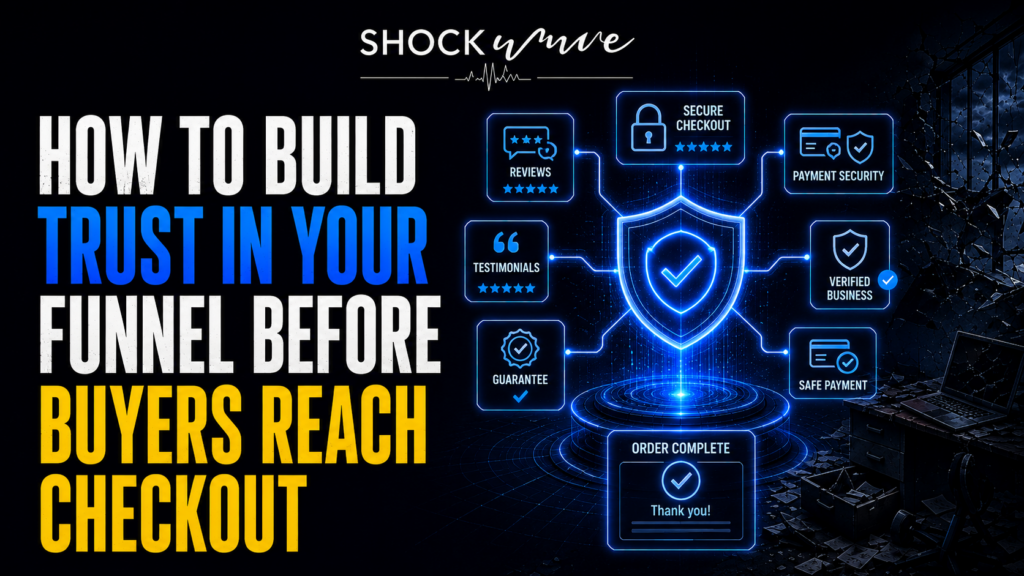
If buyers are worried about payment security, SSL, payment icons, and security badges matter.
If buyers are worried the product will not work, testimonials, case studies, demonstrations, and reviews matter.
If buyers are worried about losing money, guarantees and refund policies matter.
If buyers are worried about delivery, shipping guarantees and tracking information matter.
If buyers are worried the brand is fake, searchable presence and external credibility matter.
The best trust signals are not random.
They are matched to the buyer’s specific hesitation.
That is why understanding drop-off points matters. If people leave at checkout, they may need security and payment confidence. If they leave before adding to cart, they may need more belief in the offer. If they search and do not return, they may need stronger external proof.
Trust Is a System, Not a Section
A lot of businesses treat trust like a section on the page.
They add three testimonials, a few icons, and a guarantee block, then assume the job is done.
But trust is bigger than that.
It is the consistency between the ad and the page.
It is the quality of the website experience.
It is the proof behind the claims.
It is the clarity of the checkout.
It is the presence of real reviews.
It is the professionalism of the brand.
It is the buyer’s ability to verify the product outside the funnel.
When all of those pieces work together, the buyer feels safer moving forward.
When one of them breaks, the funnel leaks.
The Real Question
If people are making it to checkout and leaving, do not immediately assume the copy failed.
Ask what trust signal was missing.
Ask what part of the experience created doubt.
Ask whether the buyer felt safe enough to finish.
Because conversion is not only about persuasion.
It is about confidence.
And the closer someone gets to buying, the more confidence matters.
Want to build stronger backend systems that support your ads, funnels, checkout, follow-up, and customer journey?
Check out the AI Workforce Lab Bootcamp:
https://theaiworkforcelab.com/bootcamp?utm_source=podcast&utm_medium=ftybr&utm_campaign=ep09&utm_id=yt