An AI agent manager is becoming a real operational need for businesses that want AI agents to do more than produce random outputs.
The moment an AI agent starts supporting customer service, fulfillment, QA, reporting, marketing, project management, or delivery, the question changes. It is no longer only about whether the agent can complete a task once. The real question is whether the agent can keep completing the right task, in the right way, with the right level of accuracy, inside the rules of the business.
That is where many companies run into trouble. They build the agent, test it a few times, get excited by the output, and then start handing it more responsibility without building the management layer around it. A good prompt might create one useful result, but it does not tell you whether the agent is reliable over time. It does not track mistakes, monitor drift, check quality, or show you when the agent needs retraining.
If a business wants AI agents to act more like real operational support, it needs some version of an AI agent manager: a system that reviews performance, catches issues, tracks accuracy, and helps decide whether the agent should keep working, be retrained, or be rebuilt.
Why AI Agents Need Management
AI agents can move quickly through tasks, but speed creates a new requirement: visibility. The faster an agent can complete work, the more important it becomes to know whether that work is correct.
A human employee does not become reliable because someone gave them a job description. They need onboarding, examples, feedback, standards, and a manager who can tell when performance starts to slip. AI agents need a similar structure, especially if they are being used for work that touches customers, revenue, data, fulfillment, or internal decision-making.
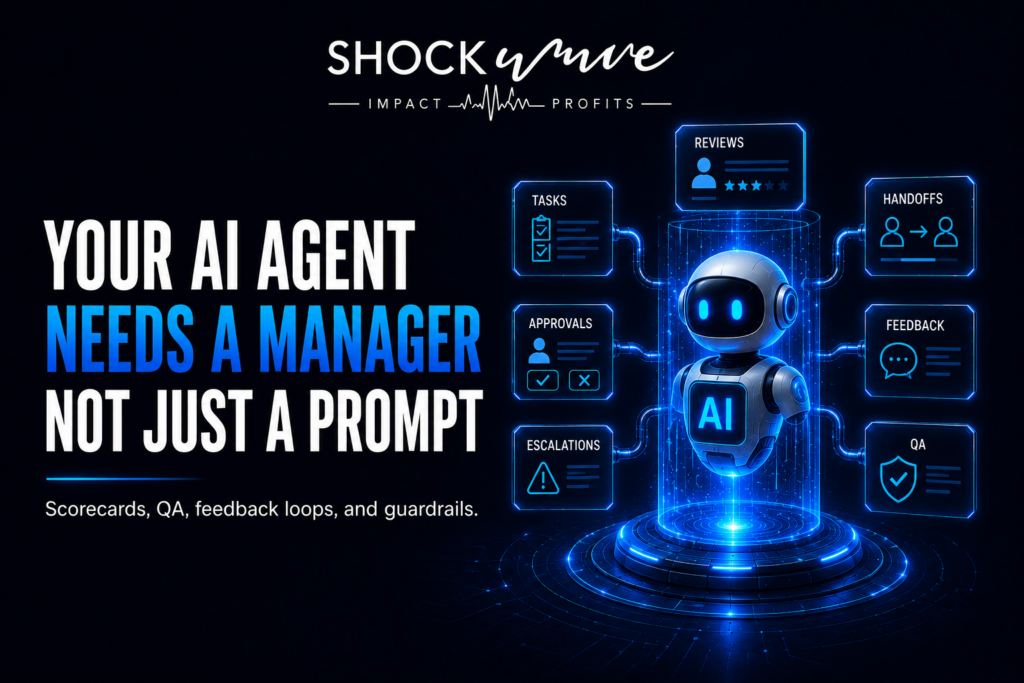
An AI agent manager does not have to be a person sitting there all day reading every output. The better model is a review system. That system can include scorecards, internal QA agents, feedback loops, Slack alerts, ClickUp reviews, escalation rules, and simple performance metrics that tell the operator where to look.
This connects directly to the bigger point from AI Agents or AI Employees? The Difference That Matters. An AI agent becomes more useful when it has a role, standards, supervision, and accountability. Without those pieces, the agent may be powerful, but it is still just another tool someone has to watch manually.
A Prompt Does Not Prove the Agent Works
A prompt is the beginning of the agent’s instruction set. It tells the agent what to do, what context matters, and what kind of output is expected. That matters, but it is not enough to manage performance.
A business needs to know whether the agent followed the process correctly after the prompt was given. Did it use the correct source material? Did it follow the SOP? Did it stay within its permissions? Did it know when to escalate? Did the final output require cleanup from a human? Did it miss a step that could create risk later?
Those questions are operational questions, not prompt-writing questions.
This is why AI agents often expose weaknesses in the business around them. If the SOP is unclear, the agent will interpret. If the workflow has missing steps, the agent may skip them or invent a path. If nobody has defined what “done” means, the agent may produce something that looks complete while still leaving important work unfinished.
The workflow gives the agent structure. The management layer tells the business whether the agent is performing inside that structure.
What an AI Agent Manager Should Monitor
An AI agent manager should not track everything just because the data exists. The goal is to identify the few signals that show whether the agent is creating leverage or creating cleanup work.
For a customer service agent, the scorecard might include response accuracy, escalation quality, tone compliance, ticket resolution time, refund prevention, and the number of corrections needed from a human.
For a reporting agent, the scorecard might include data accuracy, source usage, formatting consistency, deadline reliability, and whether the agent flagged anomalies correctly.
For a project management agent, the scorecard might include whether it identified blocked tasks, summarized priorities correctly, tagged the right owner, and sent alerts only when something actually needed attention.
The exact metrics depend on the job. The principle stays the same: the agent needs to be judged against the role it was hired to perform.
A simple AI agent scorecard can include:
→ Accuracy of the final output
→ Completion of required workflow steps
→ SOP compliance
→ Number of human corrections required
→ Correct use of source material
→ Proper escalation behavior
→ Security and access compliance
→ Consistency over time
→ Time saved compared with manual work
→ Business impact of the completed task
This is also where simplicity matters. Emma’s point in the episode about finding one key KPI is important because most businesses drown in noise. The best management systems do not create more dashboards for the sake of dashboards. They help operators know where to look.
Using AI Agents to Manage Other AI Agents
One of the most practical ideas from the episode is using one agent to monitor another agent. This is where an AI agent manager can be built as part of the AI workforce instead of becoming another manual responsibility for the team.
For example, a business may have one agent that completes a task and another agent that reviews that task against a scorecard. The review agent can check the output, compare it to the SOP, flag mistakes, and summarize whether the work needs human attention.
That type of setup is especially useful when agents are active across multiple parts of the business. If the company has agents supporting customer service, reporting, fulfillment, task management, QA, or marketing operations, a human operator should not have to inspect every single output manually. The review layer should surface the exceptions.
This is where orchestration becomes important. In Automation Moves Tasks. Orchestration Moves the Business, we explained the difference between moving isolated tasks and coordinating how work travels through the business. An AI agent manager is part of that orchestration layer because it helps decide what continues, what gets escalated, and what needs correction.
The goal is not to remove human judgment. The goal is to protect human judgment from being buried under low-value review work.
How Often Should AI Agents Be Reviewed?
AI agents should be reviewed often enough to catch issues before they compound. The right cadence depends on the risk level of the work.
A low-risk internal summarization agent may only need periodic review. A customer-facing agent should be reviewed more closely. An agent that touches financial data, compliance, passwords, customer records, or live systems needs stricter oversight.
In the episode, Emma describes reviewing active agents every three days and scoring them on a one-to-five scale. That kind of system creates a simple operating rhythm. Agents that perform well do not require unnecessary attention. Agents that begin slipping get reviewed. Agents that repeatedly miss the mark get retrained or rebuilt.
That is the practical value of an AI agent manager. It prevents the business from managing every agent equally. Strong agents keep working. Weak agents get attention. Risky agents get escalated.
This is the same principle behind scaling operations in general. In How to Scale Smarter Without Breaking Your Business, the point was that growth exposes the parts of the business that cannot handle pressure. AI agents can create the same kind of pressure internally. If output increases but review systems are missing, the business may not realize where quality is dropping until customers, staff, or revenue start feeling the damage.
What Happens When an Agent Fails?
An AI agent failure should not automatically create panic. It should create a review path.
The first question is whether the agent failed because it was poorly built, poorly trained, under-contextualized, connected to the wrong data, or operating inside a broken workflow. In many cases, the agent is not the root problem. The agent is revealing that the business never fully defined the process.
A useful review process might look like this:
→ Identify the failed output or missed step
→ Check the SOP the agent was supposed to follow
→ Review the examples the agent was trained on
→ Confirm whether the agent had access to the right information
→ Check whether the definition of done was clear
→ Decide whether the issue requires a prompt update, SOP update, data cleanup, workflow change, or full rebuild
That last point matters. Sometimes the agent needs retraining. Sometimes the workflow needs fixing. Sometimes the business needs to accept that the agent was built too early.
This is why AI Agents Won’t Fix a Business That Doesn’t Have a System should be part of the conversation. An AI agent can support a system, but it cannot replace the need for one. If the underlying process is unclear, the agent manager may keep catching problems that should have been solved upstream.
Security Is Part of Agent Management
An AI agent manager also needs to monitor security behavior. This becomes more important as agents receive access to tools, files, business data, APIs, CRMs, support platforms, project management systems, and internal documentation.
Good agent management should answer questions like:
→ What tools can this agent access?
→ What tools should this agent never access?
→ Where are API keys stored?
→ What data can the agent read?
→ What data can the agent modify?
→ When does a human need to approve an action?
→ What happens if the agent encounters confidential information?
→ How are passwords handled?
→ What activity gets logged?
Security should not be treated as a technical afterthought. It is part of operations. An agent that can execute tasks needs boundaries around where it can go and what it can do.
In the episode, the discussion around API keys, private GitHub settings, LastPass, access rules, and employee handbook-style guardrails makes the point clearly. AI agents need policies just like human team members need policies. The more autonomy they have, the more important those policies become.
Before You Build Another Agent, Build the Management Layer
Most businesses do not need more disconnected AI experiments. They need a clearer way to decide which agents are working, which ones need help, and which ones should not be trusted with more responsibility yet.
Before building the next AI agent, ask:
→ Who or what will review this agent’s work?
→ What scorecard will be used?
→ What does good performance look like?
→ What does failure look like?
→ How often will the agent be assessed?
→ What gets escalated to a human?
→ What should the agent never touch?
→ What happens when the agent makes the same mistake twice?
→ Where does the feedback get stored?
→ Who owns the agent long-term?
These questions turn AI from a tool experiment into an operational system.
Final Thought
An AI agent manager is not optional once agents start doing meaningful work inside the business. The management layer is what helps agents become more reliable over time.
A prompt can start the work. A workflow can guide the work. A scorecard can evaluate the work. A feedback loop can improve the work. A manager, whether human or agent-based, helps the business know when to trust the output and when to intervene.
If you want AI agents to support operations, customer service, fulfillment, QA, reporting, and delivery, the goal is not just to build more agents. The goal is to build agents that can be supervised, measured, improved, and safely integrated into the way the business actually runs.
Ready to build AI agents inside real business workflows? Check out the AI Workforce Bootcamp here:
https://theaiworkforcelab.com/bootcamp