
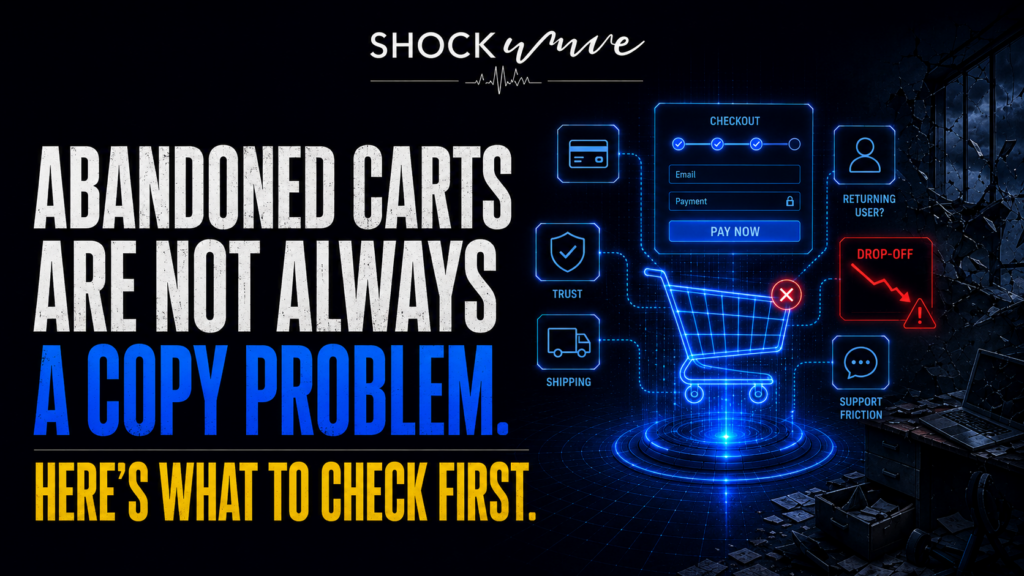
Abandoned carts are one of the most frustrating problems in an online business.
The buyer was right there.
They clicked the ad.
They visited the page.
They looked at the offer.
They added the product to the cart.
They got close to buying.
Then they left.
For a business owner, that feels personal. It feels like the funnel failed at the worst possible moment. And when that happens, the natural reaction is to blame the copy.
But abandoned carts usually do not mean the copy failed.
In many cases, abandoned carts mean the copy worked well enough to create buying intent, but something later in the funnel broke the buyer’s confidence.
That distinction matters.
Because if you misdiagnose an abandoned cart problem as a copy problem, you may waste time rewriting the wrong part of the funnel while the real leak stays untouched.
An Abandoned Cart Means There Was Interest
A buyer does not add something to cart for no reason.
They may not be fully committed yet, but they have shown interest. They understood enough of the offer to take action. They were curious enough to move forward. They saw enough value to consider paying.
That does not mean the sale is guaranteed.
But it does mean the problem is probably not at the very beginning of the funnel.
If the copy were completely ineffective, the buyer likely would not have made it that far. They would have bounced from the page, ignored the button, or never engaged with the offer.
An abandoned cart is a different kind of signal.
It tells you the buyer got close and then something created hesitation.
Your job is to find out what.
Checkout Is Where Doubt Gets Louder
The checkout process changes the buyer’s mindset.
Before checkout, the buyer is evaluating the offer.
At checkout, the buyer is evaluating risk.
They are asking different questions:
Can I trust this company?
Is my payment information safe?
Will I actually receive what I am buying?
Is the price still worth it?
Are there surprise fees?
Can I return it?
Do other people trust this product?
Does this feel legitimate?
This is why checkout pages are so sensitive.
A page that feels fine to you can feel risky to a buyer. Missing security signals, unclear policies, confusing layout, surprise shipping, weak branding, or a checkout experience that feels disconnected from the rest of the funnel can all make someone pause.
And when buyers pause at checkout, many of them do not come back.
Trust Signals Reduce Checkout Anxiety
Trust signals are not decorative.
They are conversion support.
A testimonial is not just a nice quote. It tells the buyer someone else took the risk first.
A review is not just social proof. It gives the buyer evidence from people who already purchased.
A money-back guarantee is not just a policy. It reduces the perceived downside of making the wrong decision.
Payment icons are not just design elements. They make the checkout feel familiar and legitimate.
SSL is not just technical infrastructure. It tells the buyer the site is secure.
These things matter because checkout is a moment of uncertainty.
The buyer is about to exchange money for a promise. The more unfamiliar your business is, the more trust support they need before they complete that transaction.
Do Not Fake Trust
Trust signals only work long-term if they are real.
Fake reviews, fake testimonials, fake scarcity, fake guarantees, and fake credibility markers may create short-term lift, but they damage the business underneath.
Real buyers are more skeptical than ever. They can sense when something feels manufactured. Even if they cannot prove it, the feeling of “this seems off” is enough to make them leave.
If you need more trust, build more trust.
Ask real customers for reviews.
Collect real testimonials.
Make your policies clear.
Improve the checkout experience.
Add proof where buyers are hesitating.
Make your business searchable.
Show real examples, real results, and real customer experiences.
Conversion should not depend on tricking people into feeling safe.
It should come from making the buying decision easier and more credible.
The Cart Experience Itself May Be the Problem
Sometimes the buyer trusts you enough, but the cart still creates friction.
This is common when businesses use cart features because they look modern rather than because they convert.
A slide-out cart may look clean, but if the checkout button is hard to find, conversion can suffer. A multi-step checkout may seem professional, but if it creates too many decisions, buyers may abandon. A cart with unclear product details, missing totals, surprise fees, or confusing upsells can slow the buyer down at the exact wrong moment.
At checkout, clarity wins.
The buyer should know exactly what they are buying, what it costs, what happens next, and how to complete the purchase.
Every unclear step creates friction.
Every extra decision gives them more time to reconsider.
Look at the Numbers Before Rewriting the Funnel
Abandoned carts should be diagnosed with data.
You want to know:
How many people viewed the product page?
How many clicked the buy button?
How many added to cart?
How many initiated checkout?
How many completed purchase?
Where is the biggest drop-off?
That sequence tells you where to look first.
If product page views are high but add-to-cart is low, the product page may need work.
If add-to-cart is high but checkout starts are low, the cart experience may be the issue.
If checkout starts are high but purchases are low, the checkout page may be creating friction or distrust.
If purchases happen but refunds are high, the expectation set before purchase may not match the delivery after purchase.
Each metric tells a different story.
You cannot fix the funnel properly until you know which story the data is telling.
External Trust Can Help Internal Conversion
Sometimes buyers leave checkout because they need one more layer of validation.
They may open Google.
They may search the product name.
They may look for reviews.
They may check social media.
They may see whether the brand exists anywhere else.
If they find nothing, trust drops.
This is especially important for brands running paid traffic to cold audiences. Cold buyers do not know you. They have no relationship with your company. They are evaluating you quickly, often with skepticism.
Having a credible online presence outside of the funnel helps reduce that skepticism.
That could include organic content, reviews, product listings, social proof, search results, marketplace presence, or customer stories.
The funnel does not exist in isolation.
Buyers check the world around it.
What to Fix First
Before rewriting the copy, inspect the cart and checkout experience.
Make sure the page is easy to use.
Make sure the checkout button is obvious.
Make sure totals and fees are clear.
Make sure the page has visible trust signals.
Make sure reviews and testimonials are real.
Make sure your policies are easy to find.
Make sure the page is secure.
Make sure the experience works well on mobile.
Make sure buyers are not surprised at the last step.
Then use behavior tools to watch what people actually do.
If people are getting stuck, confused, or hesitating in the same place, that is your clue.
The Real Meaning of an Abandoned Cart
An abandoned cart is not just a lost sale.
It is feedback.
It tells you the buyer got close, but not close enough. It tells you the funnel created interest, but failed to create enough confidence. It tells you something in the final stretch needs attention.
That something might be copy.
But more often, it is trust, friction, usability, or checkout experience.
So before you start over, slow down and diagnose the leak.
The buyer already showed interest.
Now your job is to remove the thing that made them leave.
Want to build the backend systems that stop leads and buyers from leaking out of your business?
Check out the AI Workforce Lab Bootcamp:
https://theaiworkforcelab.com/bootcamp?utm_source=podcast&utm_medium=ftybr&utm_campaign=bp&utm_id=wp