
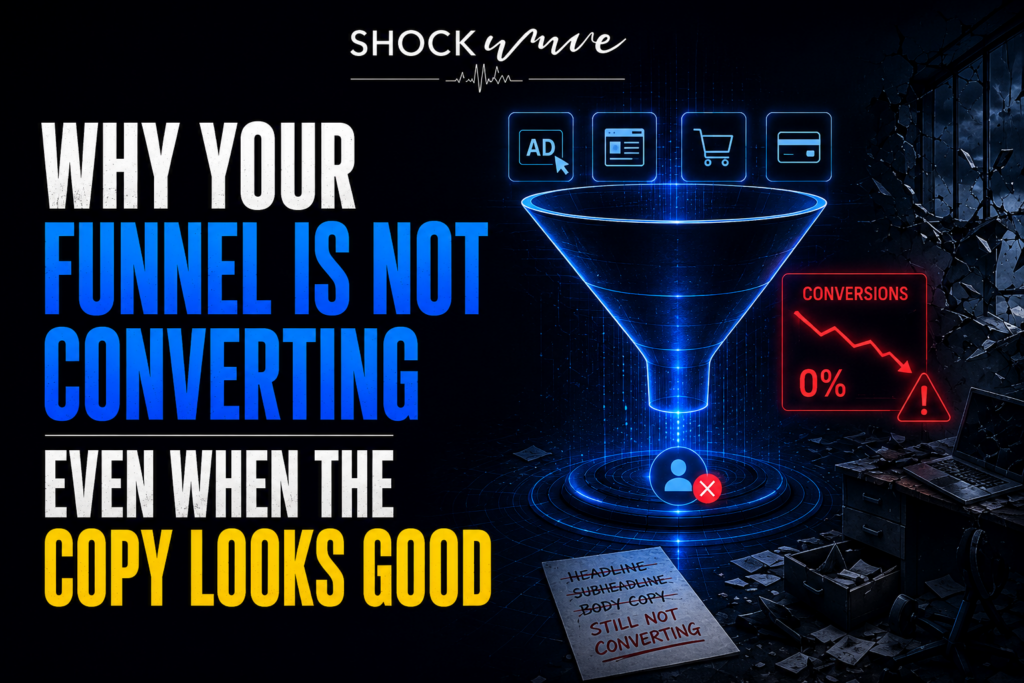
When a funnel stops converting, the first thing most business owners want to blame is the copy.
The headline is not strong enough.
The offer is not clear enough.
The sales page needs a rewrite.
The button copy is not persuasive enough.
The hook is not pulling people in.
And sometimes, that is true.
But not always.
One of the biggest mistakes business owners make when diagnosing a funnel is assuming that every conversion problem is a copy problem. In reality, your funnel may be doing a much better job than you think. If people are clicking the ad, reading the page, adding to cart, and making it all the way to checkout, the copy has already created enough interest to move them forward.
That does not mean the funnel is perfect.
It means the problem may be happening somewhere else.
Before you rewrite the entire sales page, you need to understand where people are dropping off and what that drop-off actually means.
A Broken Funnel Is Not Always a Copy Problem
Bad copy usually shows itself early.
If people land on the page and immediately leave, the message may not be connecting. If they never click the button, never scroll, never engage, or never get to the offer, then yes, you probably have a page or copy issue.
But if people are making it deeper into the funnel, that tells a different story.
Someone who clicks through to checkout is not completely uninterested. Someone who adds to cart is not confused about whether they want the product. Someone who initiates checkout has moved past curiosity and into buying consideration.
That is a major difference.
At that stage, the question is no longer, “Was the copy compelling?”
The better question is, “What made them hesitate?”
That hesitation may have nothing to do with the headline. It may have nothing to do with the offer. It may have nothing to do with the sales page.
It may be a trust problem.
It may be a checkout problem.
It may be a website usability problem.
It may be a backend problem that only becomes visible once the buyer gets close to paying.
Diagnose the Exact Place Where Buyers Leave
The fastest way to misdiagnose a funnel is to look at the whole thing as one big problem.
A funnel is not one asset. It is a sequence.
The ad has one job.
The landing page has one job.
The product page has one job.
The cart has one job.
The checkout page has one job.
The confirmation and follow-up have one job.
When revenue drops or conversions stall, you have to look at each step separately.
If people are clicking the ad but not staying on the page, the problem may be message match. The ad created one expectation, but the page delivered something else.
If people are reading the page but not clicking the call to action, the problem may be the offer, the positioning, the price reveal, or the page structure.
If people are adding to cart but not buying, the issue is probably not the top of the funnel. It is more likely something in the cart, checkout, trust layer, or buying experience.
That is why looking at the exact drop-off point matters.
The page where people leave is usually the page where the real objection appears.
Website Problems Can Look Like Funnel Problems
A lot of businesses underestimate how much the website itself affects conversion.
A page can have solid copy and still lose sales if the buyer experience feels clunky, confusing, outdated, or unsafe.
This is especially true in ecommerce.
A cart that looks slick to the business owner may feel confusing to the buyer. A checkout button hidden at the bottom of a slide-out cart may seem modern, but it can create unnecessary friction. A page with too many steps, unclear buttons, slow loading, or poor mobile formatting can quietly kill conversion before anyone realizes what happened.
The buyer does not always stop and think, “This checkout experience is not optimized.”
They just leave.
That is why a funnel audit has to include the website experience, not just the copy. You need to know whether buyers can easily understand where they are, what to do next, what they are getting, what it costs, and whether they can trust the purchase.
If any of those things are unclear, conversion drops.
Your Product Should Be Searchable
Another overlooked trust issue is what happens when someone searches for you.
If a buyer types your product or brand name into Google and finds nothing, that creates doubt. It does not mean every product needs a massive brand presence, but there should be some proof that the product exists outside of the funnel.
That can come from a real website, reviews, listings, content, press, social proof, marketplace presence, or other credible digital footprints.
For certain products, even an Amazon listing can help create external trust. The goal is not always to sell through Amazon. Sometimes the goal is to give skeptical buyers another place to verify that the product is real.
That matters because modern buyers rarely move in a straight line.
They click.
They compare.
They search.
They read reviews.
They look for proof.
Then they decide.
If your funnel is the only place your product exists, you may be making the trust hurdle harder than it needs to be.
When It Actually Is the Copy
None of this means copy does not matter.
Copy absolutely matters.
If buyers do not understand the offer, the page needs work. If they never click the call to action, the page needs work. If they do not believe the promise, the copy needs work. If they are not emotionally or logically compelled to continue, the copy needs work.
But copy should not be the automatic scapegoat.
The real issue is sequence.
If buyers never leave the sales page, look at the copy and page structure.
If buyers make it to checkout and leave, look at checkout friction, trust, fees, usability, payment options, guarantees, and buyer confidence.
If buyers add to cart but do not complete the purchase, look at the cart experience.
Different drop-offs mean different problems.
Use Behavior Tools Before You Guess
Tools like Hotjar can help you see what buyers are actually doing on the page.
Where do they stop scrolling?
Where do they click?
Where do they rage click?
Where do they hesitate?
Where do they abandon?
That kind of behavior data is much more useful than guessing.
Without it, business owners often rewrite the wrong thing. They change the headline when the checkout button is the problem. They rebuild the offer when the cart is confusing. They rewrite the sales page when the issue is missing trust signals.
A better diagnosis saves time, money, and momentum.
The Real Lesson
Your funnel is not just your copy.
It is the full path from click to customer.
The copy may get people interested, but the rest of the funnel has to help them feel safe enough to buy.
So before you throw away the sales page and start over, look at the numbers. Look at the drop-off. Look at the buyer experience. Look at the trust signals. Look at the checkout.
Because if people made it all the way to checkout, they were interested.
The real question is:
What made them leave?
Want to build stronger backend systems that turn traffic into revenue instead of letting buyers leak out of broken funnels?
Check out the AI Workforce Lab Bootcamp:
https://theaiworkforcelab.com/bootcamp?utm_source=podcast&utm_medium=ftybr&utm_campaign=bp&utm_id=wp