Learning how to scale without hiring is becoming one of the biggest advantages for growing online businesses.
When ads start working, the business does not just get more customers. It gets more tickets, more orders, more deliverables, more questions, more exceptions, more QA, more reporting, and more places where the team can drop the ball.
For years, the default response was simple.
Hire more people.
Support is overwhelmed? Hire.
Fulfillment is behind? Hire.
Reporting is messy? Hire.
Delivery is slipping? Hire.
The problem is that hiring under pressure often creates more chaos than capacity.
In this episode of Follow the Yellow Brick Road, Emma Rainville and Mitch Barham talk about a different way to scale: building systems and AI agents that help the team handle more work without drowning in it.
Not replacing the team.
Upgrading what the team can manage.
Before you can scale smarter, you need to understand what actually breaks under pressure. Read Why Scaling Ads Too Fast Breaks Businesses for the full breakdown of how growth exposes weak operations.
How to Scale Without Hiring When Growth Hits
Growth creates pressure before it creates freedom.
When a business is small, weak systems can hide.
A founder can manually fix issues. A team member can remember the workaround. Someone can jump into Slack, chase the order, message the customer, update the sheet, and patch the problem by hand.
At low volume, that can feel manageable.
At higher volume, it becomes a trap.
Once ads start working, every manual workaround gets multiplied.
Every unclear SOP creates more confusion.
Every support gap creates more tickets.
Every fulfillment delay creates more customer frustration.
Every reporting weakness makes it harder to know what is happening.
Every quality control issue becomes more expensive.
That is why growth can feel like chaos before it feels like freedom.
The business has more demand, but not enough capacity.
And capacity is not just headcount.
Capacity is the ability to handle more volume without quality, speed, accuracy, or customer experience falling apart.
Why Panic Hiring Feels Like a Fix Until It Isn’t
When everything is on fire, hiring feels responsible.
It feels like action.
The team is overwhelmed, so adding another person seems like the obvious move.
But panic hiring usually happens at the exact moment when the company has the least time to hire well.
The role is not clearly defined.
The SOPs are not ready.
The training is rushed.
The expectations are vague.
The founder is desperate.
The new person gets thrown into the mess and expected to create order inside a system that was already broken.
That rarely works.
Instead of solving the bottleneck, the business often adds another layer of management.
Now someone has to train the new hire, check their work, answer their questions, fix their mistakes, and explain processes that should have been documented before they joined.
That does not create instant capacity.
It creates operational debt.
This is why “hire for the future” can become dangerous when the business does not actually know what it needs yet.
Sometimes the smarter move is not hiring a person first.
It is building the system first.
Why AI Agents Help You Scale Without Hiring
AI agents change the way businesses can think about scale.
In the past, if volume increased, the business usually had two choices: make the existing team work harder or hire more people.
Now there is a third option.
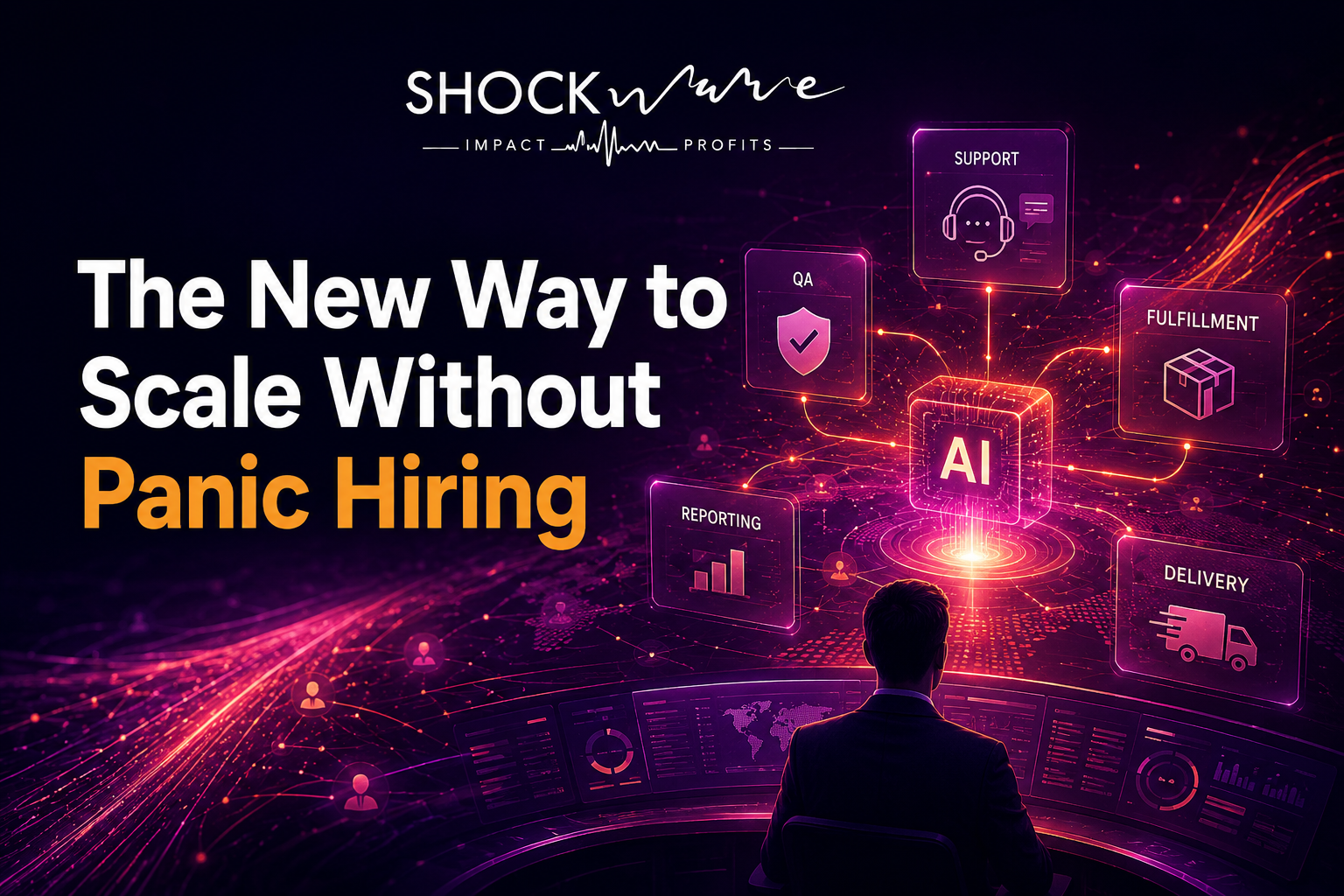
Build agent-supported workflows that handle repeatable work, surface patterns, check outputs, prepare reports, support customer service, and reduce the amount of manual execution sitting on the team’s plate.
That does not mean AI magically runs the company.
It means the business can stop using humans for every repeatable task.
Customer service agents can help answer common questions, route issues, identify patterns, and support faster responses.
QA agents can review outputs before they reach clients or customers.
Reporting agents can gather information, summarize what matters, and surface anomalies.
Fulfillment agents can support order tracking, internal handoffs, and delivery workflows.
Operations agents can help monitor recurring tasks, missed steps, and process breakdowns.
The value is not just speed.
It is consistency.
A well-built AI agent does not get tired, distracted, annoyed, or buried in Slack messages.
It can keep checking the same things the same way every time.
That gives the human team more room to think.
AI Does Not Replace the Team. It Changes the Team’s Job.
One of the most important ideas from the episode is that AI does not automatically mean getting rid of people.
The better version is different.
The team moves from doing every piece of the work manually to managing the systems that get the work done.
That shift matters.
A human support manager should not spend their entire day answering the same 15 questions.
They should be improving the support system, reviewing escalations, spotting patterns, training agents, and making sure the customer experience gets better.
An operations person should not spend all day copying data from one place to another.
They should be checking the quality of outputs, identifying bottlenecks, improving workflows, and making sure the right things happen at the right time.
A strategist should not spend hours formatting reports.
They should be interpreting the insights and deciding what to do next.
AI creates leverage when it moves humans up the value chain.
The goal is not to remove human judgment.
The goal is to stop wasting human judgment on work that should have been systemized.
The Agent Workflow That Actually Works
A smart AI workflow is not just one agent doing one task.
The better model is layered.
One agent does the task.
Another agent checks the task.
Another agent reviews it from a manager’s perspective.
Then the human team gives it a final scan, adds nuance, and approves the output.
That is a very different model from asking one AI tool to “do everything” and blindly trusting the result.
It creates checks and balances.
It gives the business speed without giving up control.
It gives the team leverage without removing accountability.
In the episode, Emma describes this kind of workflow: one agent does the task, another QAs it, another reviews it, and then the human team can do a quick review instead of manually building everything from scratch.
That is where the real operational leverage shows up.
Not in replacing every person.
In creating systems where humans are no longer the bottleneck for every repeated step.
Where AI Agents Can Create Immediate Leverage
AI agents are not useful everywhere.
But they are extremely useful in areas where the business has repeated patterns, recurring questions, predictable workflows, or high-volume review needs.
Customer service is one of the clearest examples.
A strong agent can help answer common questions, identify customer intent, route issues, summarize previous interactions, and support faster responses.
It can also help find patterns across tickets that a human team might not catch quickly enough.
QA is another obvious use case.
If the business is producing reports, deliverables, emails, documents, client updates, product checks, or fulfillment outputs, agents can review for missing information, inconsistencies, formatting issues, or quality gaps before a human gives final approval.
Reporting is another.
Most teams do not suffer because they have no data.
They suffer because they have too much data and not enough clean interpretation.
AI agents can help gather numbers, summarize movement, spot anomalies, and prepare the team to make decisions faster.
Fulfillment and delivery also benefit.
Agents can help monitor steps, flag incomplete tasks, prepare updates, check whether requirements were met, and keep workflows moving.
Even inventory and order operations can benefit when the process is clear enough.
The key is not asking AI to “figure out the business.”
The key is building agents around defined workflows.
AI Agents Need Management Too
AI agents are not magic employees.
They need structure.
They need instructions.
They need quality control.
They need clear inputs and expected outputs.
They need someone responsible for managing and improving them.
That is why the best AI-supported businesses will not be the ones that randomly add tools.
They will be the ones that build operating systems around agents.
A bad process with AI on top is still a bad process.
A confusing workflow with an agent inside it is still confusing.
A broken customer experience does not become great just because AI is involved.
The business still needs leadership.
It still needs judgment.
It still needs ownership.
It still needs people who understand the difference between automation and actual operational improvement.
That is why the human team becomes more important in a different way.
They are no longer just doing tasks.
They are designing, managing, and improving the system.
The Best Scale Plan Is Human Judgment Plus AI Execution
The strongest businesses will not be fully human or fully AI.
They will be both.
Humans bring context, nuance, taste, judgment, empathy, strategy, and accountability.
AI brings speed, consistency, pattern recognition, repeatability, and leverage.
Together, they create a stronger operating model.
The human team decides what matters.
The AI agents help get the repeatable work done.
The human team reviews the edge cases.
The AI agents keep the system moving.
The human team improves the workflow.
The AI agents execute it again and again.
That is how scale becomes more manageable.
Not by throwing more people at the mess.
Not by pretending AI can run everything alone.
But by designing a smarter division of labor.
Build Capacity Before Growth Forces Your Hand
The worst time to build capacity is after everything is already on fire.
Once the ads are working, the tickets are stacking, customers are waiting, fulfillment is slipping, and the team is overloaded, every decision gets more expensive.
That is when founders panic hire.
That is when they make messy process decisions.
That is when they overpay for help.
That is when they accept lower standards just to survive the week.
A smarter move is to build capacity before the spike.
Document the repeatable work.
Identify the common support questions.
Map the fulfillment process.
Create the QA checklist.
Define the reporting rhythm.
Find the tasks that happen every week and should not require a human from scratch every time.
Then build agents around those workflows.
That way, when growth hits, the business is not scrambling to create capacity.
It already has leverage in place.
The Logical Next Step: Installed AI Employees
This is the natural next step if you are looking at your business and realizing support, fulfillment, QA, reporting, delivery, or operations cannot keep scaling manually forever.
AI agents are not just “cool tools.”
Used correctly, they become part of the operating system of the business.
They help the team move faster, catch more, manage more, and reduce the chaos that usually comes when growth hits all at once.
Check out the AI Workforce Lab to see how trained AI employees can be installed inside your business to support customer service, fulfillment, QA, reporting, and delivery without adding more chaos to the team.
Final Takeaway
Panic hiring is not a scale strategy.
It is a reaction to capacity that should have been built earlier.
If your business is growing, the answer is not always “more people.”
Sometimes the answer is better systems.
Sometimes the answer is agent-supported workflows.
Sometimes the answer is moving your team from doing every task manually to managing the systems that get the work done.
That is the new way to scale.
Human judgment.
AI execution.
Clear workflows.
Better capacity.
Less chaos.
Join the Hidden Control Chamber for free guides, checklists, and resources built to help you turn traffic into customers — and customers into real scale.